
Research
- 01
Ionic Polymer Design and Synthesis
Designing and synthesizing charged polymers — polyelectrolytes, ionoelastomers, and high-dielectric elastomers — and learning how molecular structure sets their ionic and mechanical behavior.
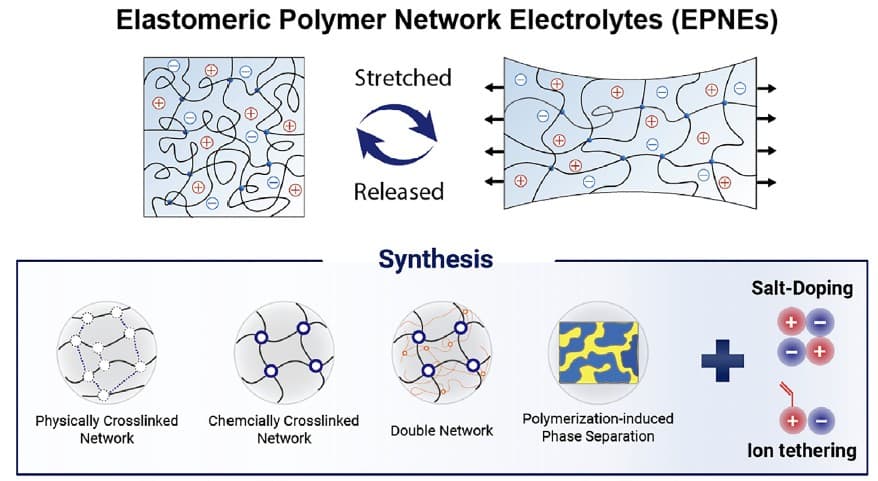
We synthesize polyelectrolytes and polymerized ionic liquids with controlled backbone chemistry, charge density, and counterion, then build them into elastomeric networks by chemical crosslinking, physical association, double networks, and polymerization-induced phase separation.
Because the ions are tethered to the network, these materials stretch and conduct at the same time. We ask how crosslink density, ion content, and salt doping set the stiffness, the dielectric response, and the charge a material can store at an electrified interface.
Selected Publications
Progress in Polymer Science, 2025 - 02
Complex Coacervation and Phase Behavior
Associative phase separation of oppositely charged polymers, and the glass transition that governs how the resulting complex behaves.
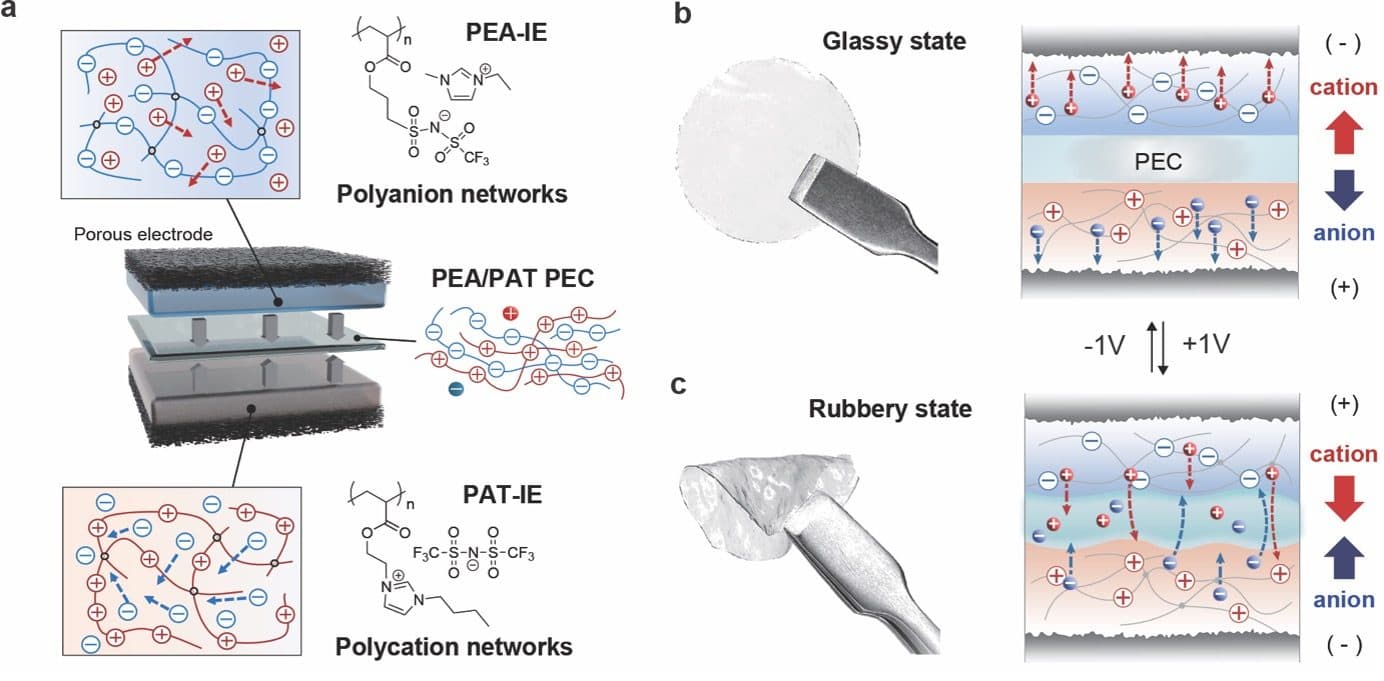
Mixing oppositely charged polyelectrolytes drives associative phase separation into a dense complex and a dilute supernatant. We map where those phase boundaries sit as a function of charge density, salt, and solvent, and connect them to the structure and mechanics of the dense phase.
That dense phase is not simply a liquid. Water and salt plasticize it, so its glass transition can be tuned — and even driven electrically. A thermodynamic question becomes a handle on how fast ions move through the complex, and on how the complex behaves when it forms at an interface.
Selected Publications
- Electrically Induced Glass Transition in Polyelectrolyte Complexes Enables Kinetic Ionic Diodes
- Kinetically Arrested Interfacial Polyelectrolyte Complexes within Ionic Double Layers
- Influence of Solvent Dielectric Constant on the Complex Coacervation Phase Behavior of Polymerized Ionic Liquids
Nature Communications, 2026 - 03
Soft Ionic Devices, Iontronics, and Electro-Adhesion
Ionoelastomer heterojunctions, the ionic double layers they form, and the low-voltage electro-adhesion they make possible.
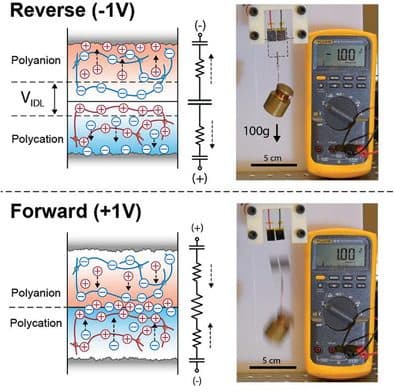
When a network of fixed anions meets a network of fixed cations, the mobile counterions rearrange into an ionic double layer at the junction. That layer responds to a few volts, so strong and reversible adhesion becomes possible at voltages a battery can supply.
We study how the double layer forms and discharges, how network elasticity shapes its capacitance–voltage response, and how the same junctions rectify ionic current. We then build that behavior into devices: electro-adhesive clutches, grippers, and robotic end-effectors that switch stiffness and holding strength on demand.
Selected Publications
Advanced Materials, 2020 - 04
Sustainable Polymer Chemistry
Breaking polymers back down to their monomers, using recoverable catalysts built from charged polymers.
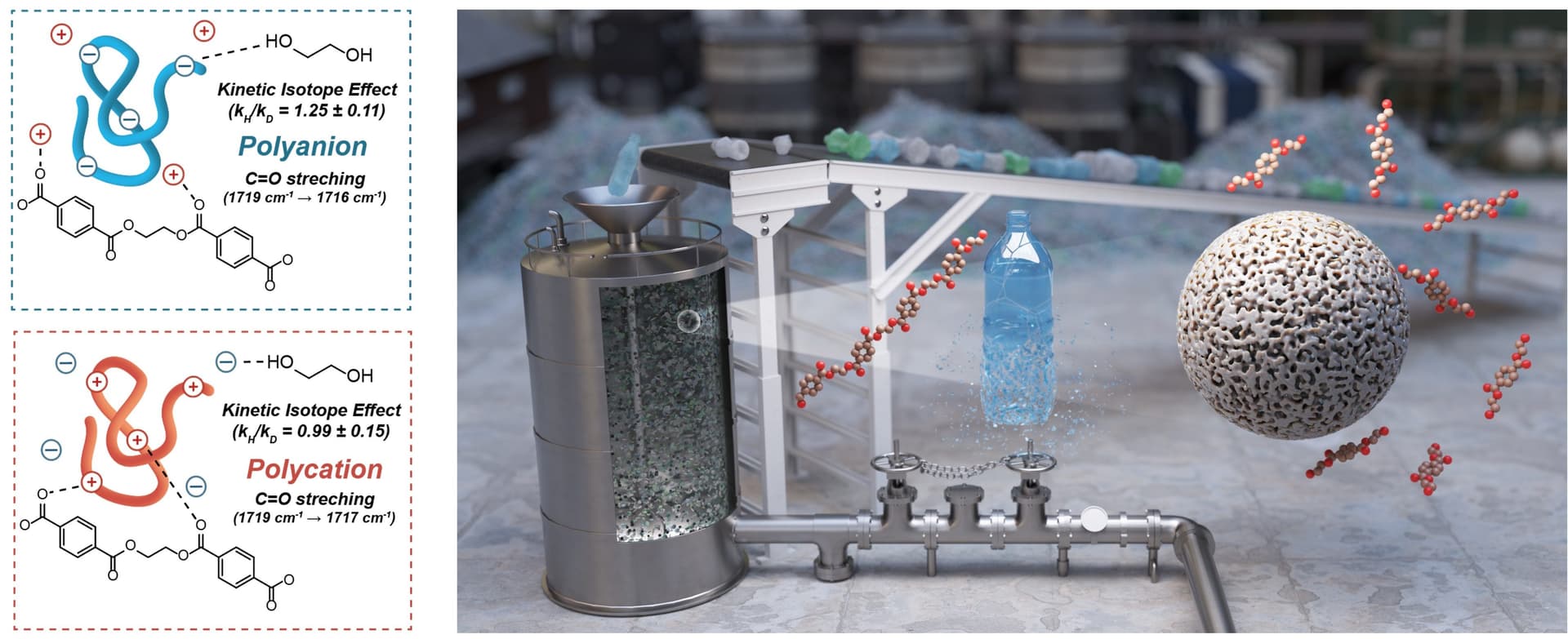
Most polymers are far easier to build than to take apart. We study depolymerization as a route to closed-loop chemical recycling, asking which linkages reopen under mild conditions and how a polymer's structure decides whether it comes back as clean monomer.
Our catalysts are macroporous polyanion beads. Because the active sites are tethered to a solid support, the catalyst can be filtered out and used again, which makes continuous operation possible — including recovery of the fibers from polyester composites.
Selected Publications
- Recoverable Macroporous Polyanion Bead Catalysts for Scalable Continuous Chemical Depolymerization of PET
- Recoverable Polyanion Bead Catalysts for Selective Depolymerization and Fiber Recovery from Polyester Composites
Nature Communications, 2026